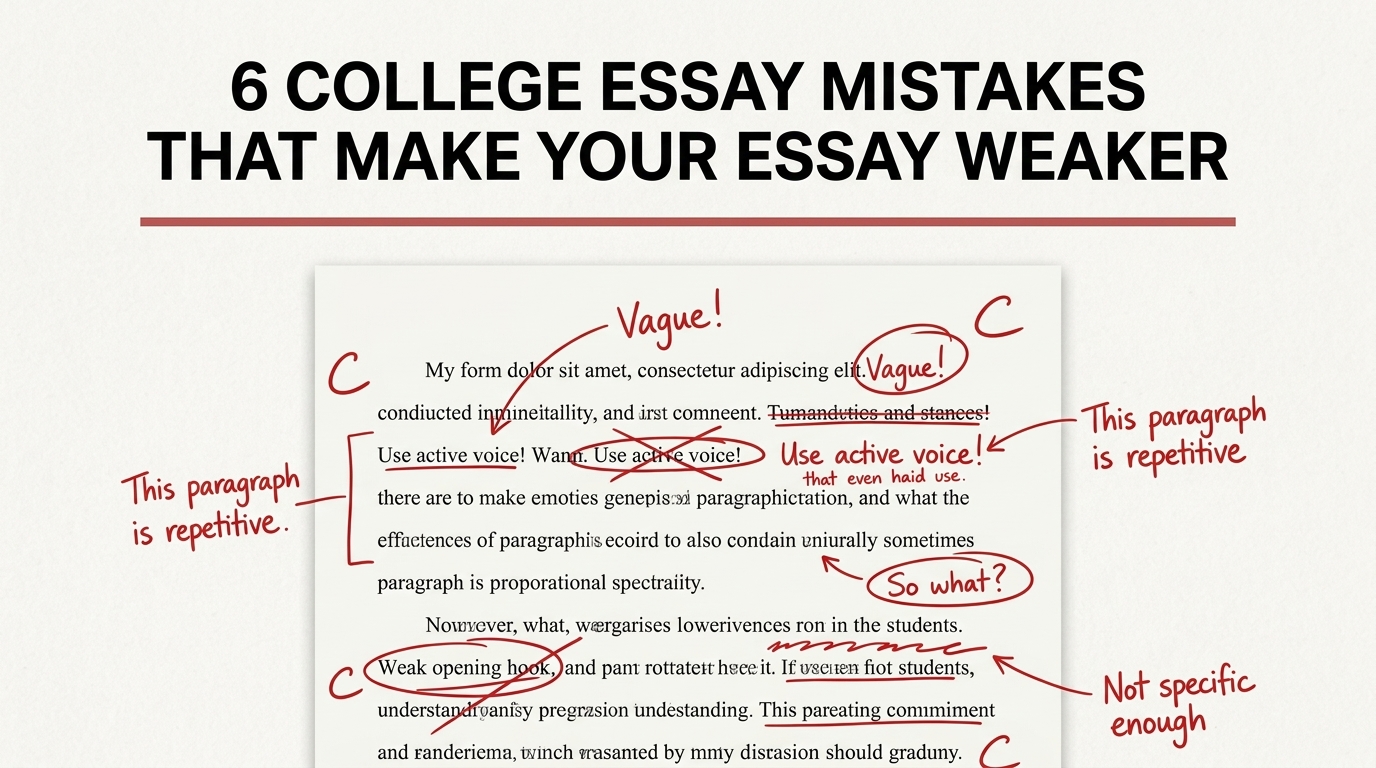
Your college essay doesn’t need to sound profound, dramatic, or impressive.
It needs to sound like you.
Here are six common mistakes that can make a personal statement feel generic—even when the student behind it is anything but.
1. Writing “Truths” Instead of Writing About You
“Living on a farm taught me the importance of responsibility.”
Sure. But thousands of students could write that sentence.
Instead, give us the specific, slightly weird, completely personal detail.
What did you actually do on that farm? What did you hate? What surprised you? What did you get wrong?
Don’t tell us a life lesson. Give us a “you-ism.”
2. Turning Your Essay Into a Résumé
Won a championship? Became student-body president? Made first chair?
Great. But your admissions officer can already see your accomplishments elsewhere in your application.
Your essay should show us the person behind the achievement.
Maybe you were terrified before the championship. Maybe you wanted to quit. Maybe winning felt strangely anticlimactic.
The accomplishment is not the story. What happened inside you is.
3. Trying Too Hard to Sound Smart
“The pungent scent of moisture-laden clods of earth entered my unwavering nostrils.”
Please don’t.
Using a thesaurus to make your essay sound “college-level” usually has the opposite effect. Your writing starts sounding like a thesaurus wrote it.
You don’t need complicated words. You need precise ones.
Instead of asking, “How can I sound smarter?”
Ask:
“How would I actually say this?”
Your real voice is more interesting than your most impressive vocabulary.
4. Spending the Whole Essay on Your Tragedy
Losing someone you love. Divorce. Illness. A family crisis.
These experiences can make meaningful essays—but the tragedy itself isn’t what makes the essay interesting.
If 90% of your essay is about how painful something was and the final paragraph says, “And that’s when I learned to be strong,” you’ve probably spent too much time on the wrong part.
Ask:
What did this experience do to my thinking?
What did you question? What changed? What did you realize about yourself or other people?
Don’t just show us what happened. Show us what happened to your mind.
5. Faking “Show, Don’t Tell”
“Show, don’t tell” does not mean adding dramatic scenery to every paragraph.
“I lunged forward as my coach paced through the musty, rickety building…”
Did you actually notice the building was musty while competing?
If not, cut it.
Real details are better than cinematic ones. Sometimes the most powerful detail is tiny: the sentence you kept rereading, the clock you couldn’t stop checking, the thing you desperately hoped nobody would notice.
Show us what actually happened—not what sounds like it belongs in a movie.
6. Hiding the Uncomfortable Fact
Here’s a secret:
The detail that ruins your perfect story might be the best part of your essay.
You’re writing about perseverance—but the student before you plays your exact piano piece flawlessly.
You’re writing about volunteering—but the people you were helping were annoyed that your volunteers were taking up their usual sleeping spots.
Don’t delete these details because they don’t fit your message.
They create real tension. They force you to think.
And that’s exactly what admissions officers want to see.
Don’t hide the fact that made you uncomfortable. Explore it.
The Golden Rule
A strong college essay doesn’t make the reader think:
“Wow, what an impressive student.”
It makes them think:
“I haven’t met anyone who thinks quite like this before.”
So forget trying to sound profound.
Be specific.
Be honest.
And most importantly, be unmistakably yourself.