Think of your college essay as a mini-movie about your life, not a résumé written in paragraphs.
Your grades, awards, activities, and achievements already appear elsewhere in your application. Your personal statement has a different job:
Show us who you are, how you think, and what matters to you.
But how do you actually structure 650 words?
You can start with two simple blueprints.
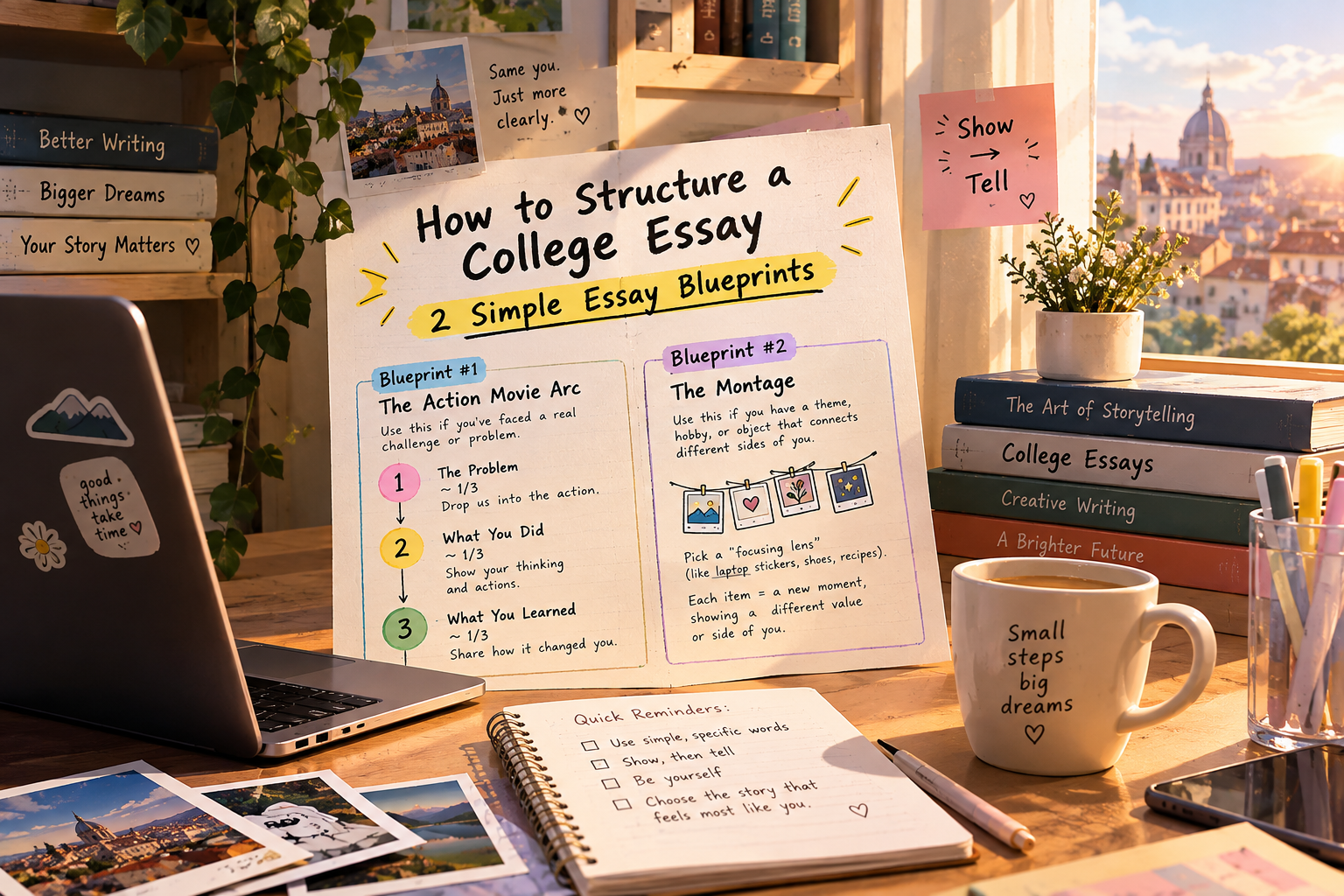
Blueprint #1: The Action Movie Arc
Use this if you have a challenge, problem, or experience that changed you.
This is the classic narrative structure: something happens, you respond, and you come away with a new understanding.
Think of your essay as three slices:
1. The Problem: ~1/3
Drop us into the action.
Don’t spend your first paragraph explaining everything that happened before the story.
Start with the moment when things became difficult, surprising, or interesting.
Show us:
- What happened?
- What went wrong?
- Why was it difficult?
- What were you thinking?
For example, instead of:
“I have always been interested in fixing things.”
Try:
“By Saturday afternoon, I had taken the radio apart three times and still couldn’t figure out why it wouldn’t turn on.”
Now we have a story.
2. What You Did: ~1/3
This is where you show your mind in action.
Don’t write:
“I worked hard until I finally solved the problem.”
Show us what “working hard” actually looked like.
What did you try?
What failed?
What did you notice?
What did you change?
Maybe you replaced a fuse. Then checked the wiring. Then realized you had been looking at the problem completely wrong.
Your actions reveal how you think.
Don’t just tell us that you’re resourceful, curious, persistent, or creative. Give us evidence.
3. What You Learned: ~1/3
Now step back.
What did the experience change?
Maybe you discovered something about yourself.
Maybe you developed a new way of approaching problems.
Maybe something you once believed became more complicated.
Think of this as the “so what?” section of your essay.
What value, perspective, or quality did you develop that you’ll carry forward?
And remember: your realization doesn’t have to be enormous.
You don’t need:
“I learned that anything is possible.”
You might discover something much more personal:
“I had always thought being resourceful meant knowing how to fix things. I began to realize it might mean knowing when the way you’re approaching a problem isn’t working.”
That’s the kind of insight that tells the reader something about you.
Blueprint #2: The Montage
Use this if you don’t have one big challenge or life-changing event.
You don’t need a dramatic story to write a memorable essay.
Instead, you can build your essay around a theme, hobby, object, place, or recurring part of your life.
Think of it as beads on a thread.
The thread is your focusing lens.
The beads are the different moments or examples you connect to it.
Pick a “thread”
Your thread could be:
- Five pairs of shoes
- Recipes you’ve learned to bake
- Objects on your desk
- Different games you play with your family
- Places you’ve lived
- Songs on a particular playlist
Each item becomes a small window into your personality.
For example:
Shoe #1: reveals your creative side.
Shoe #2: reveals your sense of humor.
Shoe #3: connects to your interest in science.
Shoe #4: reveals an unexpected friendship.
The objects aren’t the point.
What they reveal about you is.
A good montage essay creates a bigger picture from several small pieces.
The Rule That Works With Both Structures: Show, Then Tell
Whether you’re writing a narrative or a montage, you need both showing and telling.
Think of the kindergarten game “Show and Tell.”
SHOW: Give Us the Scene
Use specific, concrete details:
- What did you see?
- What did you hear?
- What did something smell like?
- What exactly did someone say?
- What object was in your hand?
- What were you doing?
Instead of:
“I was nervous.”
Try:
“My hands shook so badly that I knocked my glass of water off the podium.”
Now we can see the nervousness.
TELL: Give Us the Meaning
Once you’ve shown us the moment, explain why it matters.
What were you thinking?
Why did this moment stay with you?
What did you realize?
How did your perspective change?
This is where your essay becomes more than a story.
SHOW → THEN TELL
Don’t give us a beautiful scene and leave us to guess why it matters.
And don’t give us a list of life lessons without giving us a story to believe them.
Which Blueprint Should You Choose?
Use the Action Movie Arc if you have:
- A specific challenge or problem
- A clear sequence of events
- Something you did in response
- A meaningful change in your thinking
Use the Montage if you have:
- Several smaller moments connected by a theme
- An interesting hobby, object, or habit
- Multiple sides of your personality you want to reveal
- No single event that can carry the entire essay
And don’t choose a structure simply because it sounds more impressive.
Choose the one that lets you reveal the most interesting version of yourself.
The Simple Formula
If you’re staring at a blank document, start here.
ACTION MOVIE
Problem → What I Did → What I Realized
MONTAGE
Focusing Lens → Moment → Insight → Moment → Insight → Moment → Insight
Whether you tell one powerful story or connect several smaller ones, the right structure is the one that lets your personality and perspective come through most clearly.