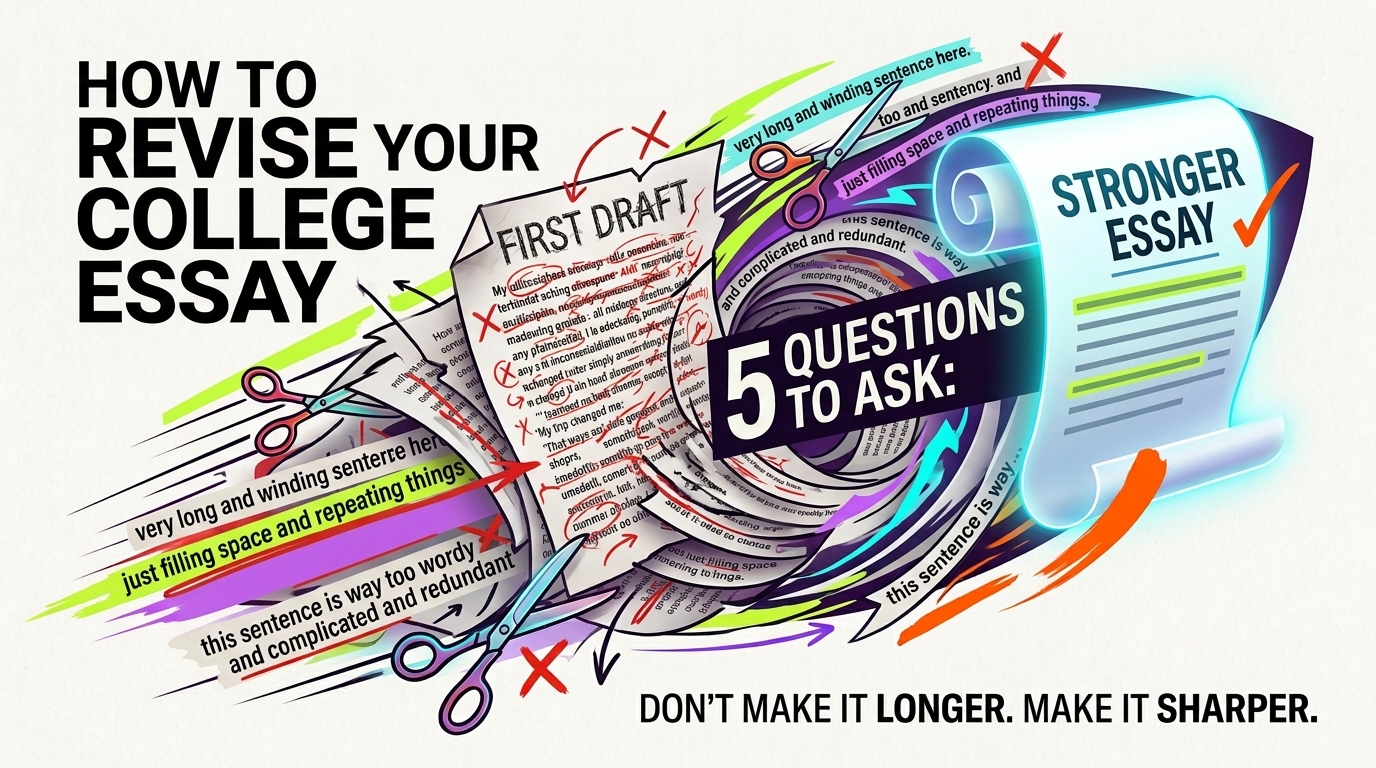
You’ve written your first draft.
Now what?
Don’t immediately start fixing grammar or replacing words with fancier ones. First, look at the ideas.
A strong college essay isn’t created by adding more words. It’s created by making sure every word is doing useful work.
Read your draft again and ask these five questions.
1. Where Am I Being Too Vague?
Look for statements that could describe almost anyone.
“I learned a lot from this experience.”
“My family has always supported me.”
“I became more confident.”
These sentences aren’t necessarily wrong. They’re just too general.
Ask:
What exactly do I mean?
Instead of:
“I became more confident.”
Try:
“For the first time, I volunteered to give the presentation without waiting for someone else to go first.”
Now the reader can actually see the change.
Whenever you find a vague statement, replace it with a specific fact, moment, or observation.
2. Where Do I Need More Detail?
Now look for the opposite problem.
Maybe you mention an important moment in one sentence and immediately move on.
“My experiment failed the night before the competition, so I had to start over.”
That’s potentially the most interesting moment in the essay.
But what actually happened?
What failed?
What did you see?
What did you do first?
What were you thinking?
What happened when that didn’t work?
You don’t need more detail everywhere.
Give more space to the moments that reveal the most about you.
3. Where Am I Repeating Myself?
First drafts often say the same thing several times.
You might write:
“I wanted to quit.”
Then:
“I seriously considered giving up.”
Then:
“There were many moments when I thought about quitting.”
You’ve made the same point three times.
Pick the strongest version.
The same applies to your ideas.
If you’ve already shown that you’re persistent, you don’t need three more paragraphs proving it.
Ask:
Does this sentence add something new?
If not, cut or combine it.
Repetition takes up space without adding meaning.
4. Where Am I Explaining Instead of Showing?
Search your essay for sentences like:
“I was nervous.”
“I was frustrated.”
“I learned to be more independent.”
“I realized how much I cared about my family.”
Then ask:
Can I show the reader what this looked like?
Instead of:
“I was nervous before the presentation.”
Try:
“I read the first sentence of my note card three times without actually taking in the words.”
Instead of:
“I realized I cared about my family.”
Show us the conversation, gesture, object, or moment that made you realize it.
Don’t just tell the reader what you felt or learned. Give them evidence.
5. What Can I Cut?
This may be the hardest question.
You wrote the paragraph. You spent time on it. You like the sentence.
It still might need to go.
Look for:
- unnecessary background
- repeated ideas
- irrelevant achievements
- explanations the reader doesn’t need
- descriptions that sound nice but reveal nothing
- sentences that don’t move the story forward
Ask:
If I delete this, does the essay lose something important?
If the answer is no, cut it.
Remember: you’re not trying to fill 650 words.
You’re trying to make the 650 words count.
The Revision Test
After you’ve gone through all five questions, read your essay one more time.
Ask:
Is every part of this essay helping me reveal something about who I am?
If a sentence is vague, make it specific.
If a moment matters, give it detail.
If an idea is repeated, say it once.
If you’re explaining, look for evidence.
If something isn’t doing useful work, cut it.
That’s revision.
Don’t make your essay longer. Make it sharper.